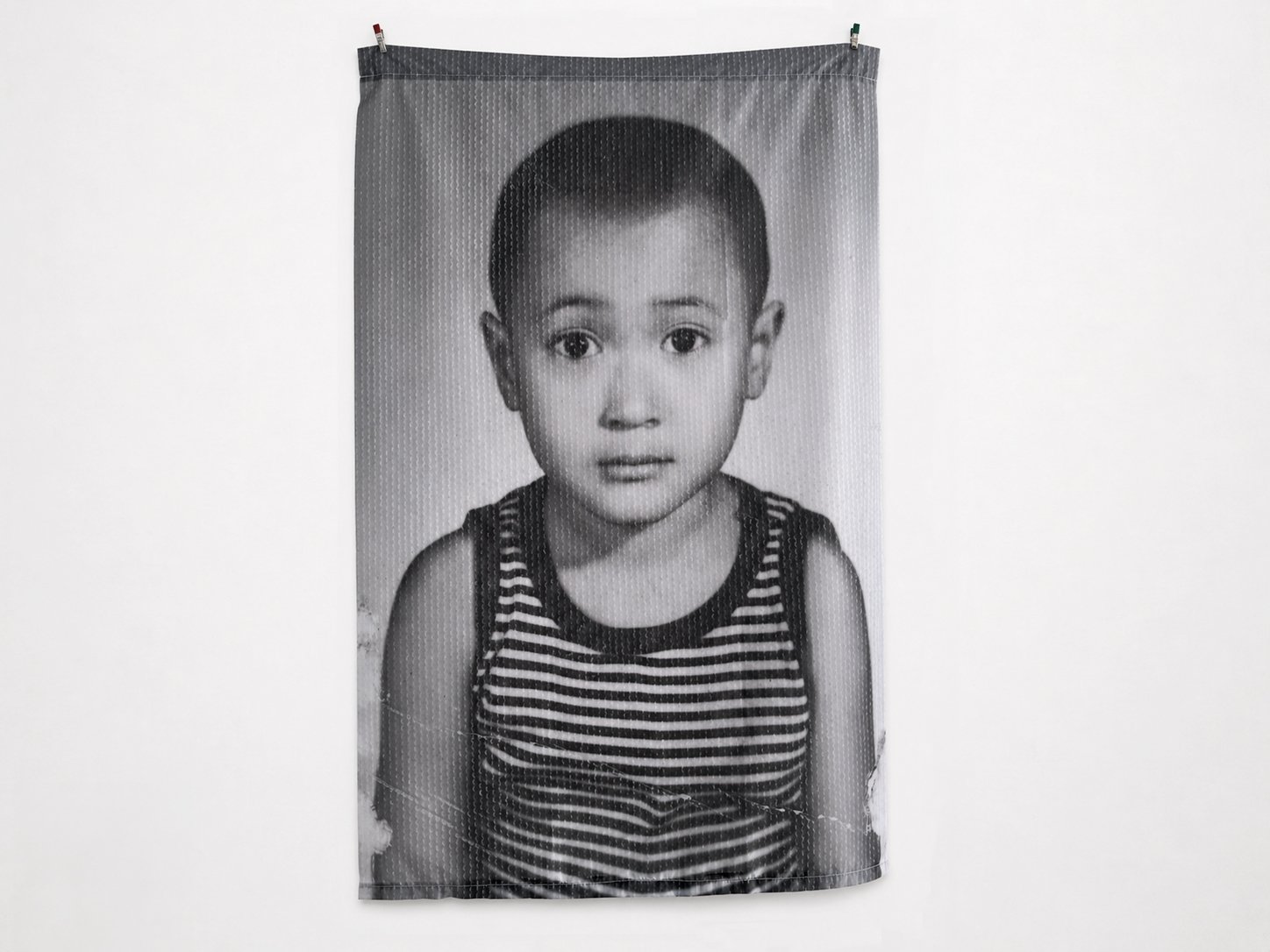
Artistic Process: Surviving Images and Their Homecoming

The Methodology: The Spirit Flag & The Anthotype

The core of this work is a homecoming for a small collection of surviving family photographs—rare fragments that escaped destruction during the Khmer Rouge era. As documented in my mother’s memoir, Survival During and After Khmer Rouge, she discovered these in her childhood home after the war. Among them was a surveillance photograph of her late sister, Avie; it is the only image of her that exists.

My research is a mission to return these images to the landscape where they began, moving them from the "carceral archive" into a space of ritual care. To do this, I utilize two specific, tactile processes:

The four portraits found in my mother’s childhood home after the Khmer Rouge Genocide.

The Spirit Flags

I re-photograph these archival portraits and print them onto large-scale, translucent fabric to create "Spirit Flags." I then install these flags at the exact coordinates in Moung Ruessei and Battambang where my family lived or is buried. These flags are designed to physically interact with the environment—moving with the wind and breathing alongside the land. This transparency allows the landscape to remain visible through the portraits, transforming a static surveillance image into a living, ephemeral memorial.

Mockup of Spirit Flag

Experimental Anthotypes

To further weave my family back into the soil, I utilize the Anthotype process—a 19th-century photographic method that replaces industrial silver or ink with plant extracts. I create a light-sensitive "emulsion" from the local flora of Battambang (leaves, flowers, or roots) and use it to coat paper. When exposed to the intense Cambodian sun, the sunlight "prints" my family’s archival portraits into the botanical emulsion. The result is a colorful, organic image literally grown from the soil and water where my ancestors remain.

I document these rituals using a 4x5 large-format view camera. This slow, deliberate methodology mirrors the psychological "self-capacities" my mother writes about: the ability to maintain a benevolent connection with the self despite surrounding trauma. By capturing these images in high fidelity, I am transforming the camera from a tool of state surveillance into a vessel for remembrance, finally completing the circle of inheritance.

The Research: Battambang, Moung Ruessei & The Topography of Memory

This project functions as a physical and historical "homecoming" centered in the district of Moung Ruessei and the wider Battambang province. Following the survival narrative documented in my mother’s memoir and thesis, Survival During and After Khmer Rouge, I am conducting field research to locate and document unmarked family burial sites and significant historical landscapes.

In post-conflict studies, we often prioritize the physical displacement of people, mapping the movement of refugees across borders and into camps. But we rarely account for the displacement of a family’s visual history. For many in the Cambodian diaspora, our inheritance is defined by a complete visual void.

My work will move from the domestic archives of the United States to the physical soil of Cambodia. Working alongside local monks and in partnership with the Cambodian Centre for Documentary Photography (CCDP), I am mapping "search grids" based on my mother’s written memories of the "men in black uniforms" who reshaped our family lineage on April 17, 1975.

Our research focus is three-fold: site-specific mapping, oral history integration, and the reclamation of forbidden family archives. In Moung Ruessei, the memory of labor camps and trauma is often buried beneath lush, vibrant rice fields. By addressing the silent presence of the Khmer Rouge era, I am using photography to bridge the gap between the Cambodian diaspora and the physical sites of resilience and loss.

Khmer Rouge Stronghold Map and Mass Burial Sites

The goal is to prove that while a regime can attempt to erase a person from the record, the land remains a witness. Through this homecoming, we are asserting that the landscape is not just a setting, it is the archive itself.